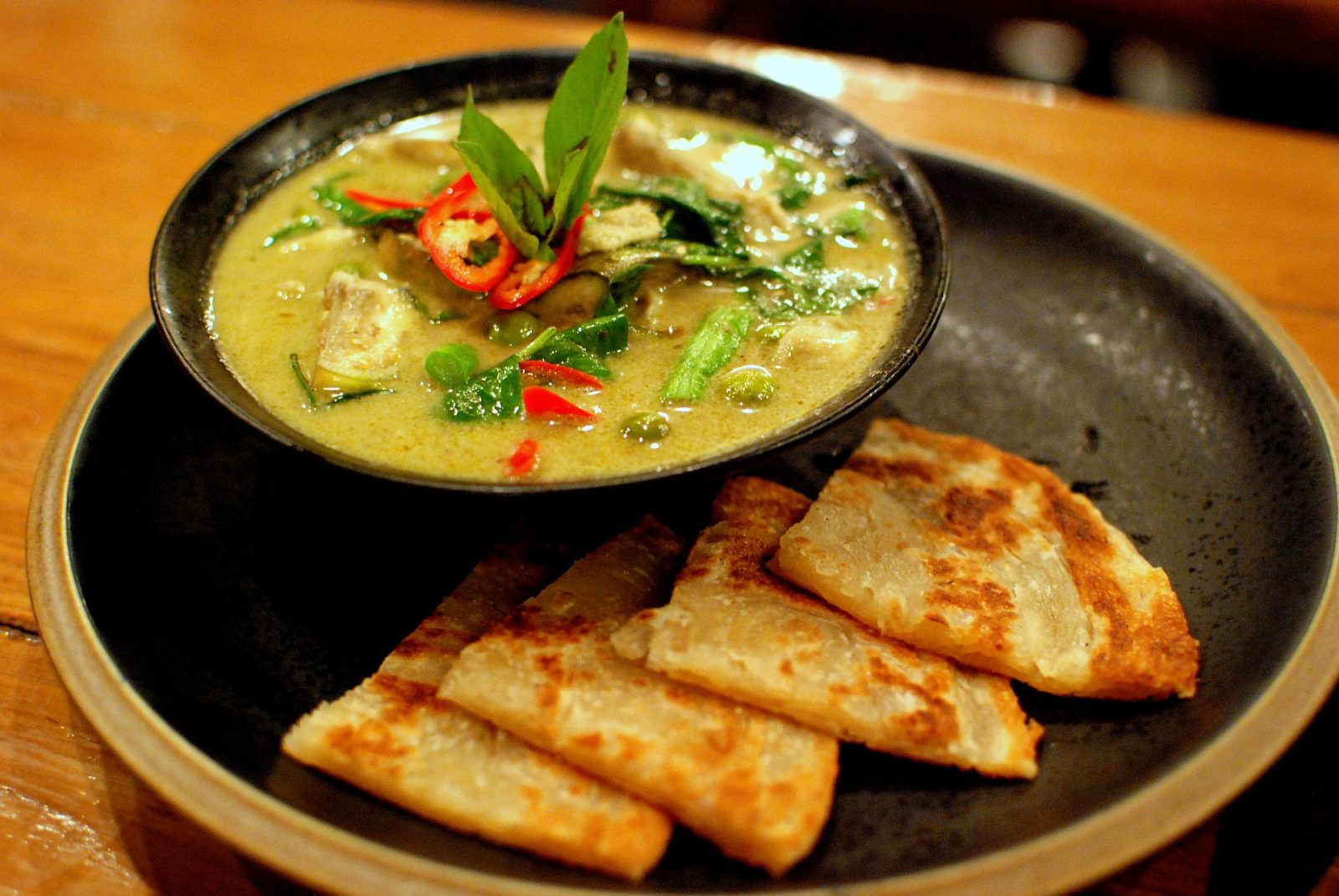
Gaeng Khiao Wan (แกงเขียวหวาน) — Central Thai Green Curry with Chicken
Declassified 22 August 2026
Threat assessment
3,000 SHUMEDIUM
- 1 No contact Nobody is in danger. Least of all the locals.
- 2 Light resistance A warmth. You mention it. Nobody responds.
- 3 Engaged You are sweating. No one else at the table is sweating.
- 4 Taking fire You have stopped talking. A child has taken your portion.
- 5 Operative down Extraction required. Locals describe this one as "not spicy".
Gaeng khiao wan is the green curry of the Central Thai plains: a wet paste of fresh green bird chillies, galangal, lemongrass, makrut lime zest, coriander root and shrimp paste, fried in coconut cream that has been cooked until its oil separates, then loosened with thinner coconut milk and simmered with chicken and apple aubergines. The name means green-sweet, which describes the colour and a faint sweetness sitting behind the salt and heat, not a sugary curry. A good one is fragrant before it is hot, loose enough to spoon over rice rather than thick like a sauce, and served with a slick of green oil on the surface. It stands or falls on two things: a paste pounded by hand, and recognising the moment the coconut cream breaks. Photo: Takeaway (CC BY-SA 3.0), via Wikimedia Commons.
// SUPPLY LIST
SCALE:
| AMT | UNIT | ITEM |
|---|---|---|
| 2 | tsp | Coriander seed, whole |
| 1 | tsp | Cumin seed, whole |
| 0.5 | tsp | White peppercorns, whole |
| 15 | g | Fresh green bird's eye chillies (phrik khi nu suan), stems pinched off, seeds left in |
| 35 | g | Long green chillies (phrik chi fa khiao), stemmed, seeds and pith scraped out, sliced |
| 2 | tsp | Fine sea salt (1 tsp goes into the paste, the rest into the aubergine water) |
| 10 | g | Galangal, young, peeled and sliced paper-thin across the grain |
| 20 | g | Lemongrass, tough outer layers stripped, bottom 10 cm only, sliced paper-thin across the grain |
| 1 | tsp | Makrut lime zest, pared thinly with a knife leaving the white pith behind, finely chopped |
| 10 | g | Coriander roots, scraped clean and finely chopped (about 4 roots) |
| 25 | g | Red Asian shallots, peeled and thinly sliced |
| 15 | g | Garlic, peeled and thinly sliced |
| 10 | g | Kapi (Thai fermented shrimp paste), straight from the jar |
| 400 | ml | Coconut cream (hua kati), unstabilised — the ingredients list must read coconut and water only, no gums or emulsifiers; fresh-pressed first extraction is better still |
| 300 | ml | Coconut milk (hang kati), thinner second extraction or a good unstabilised tinned milk |
| 500 | g | Chicken thigh, boneless and skinless, sliced across the grain into 1 cm strips |
| 200 | g | Thai apple aubergines (makhuea proh), quartered through the stem, held in lightly salted water |
| 40 | g | Pea aubergines (makhuea phuang), pulled from their stems |
| 15 | g | Palm sugar, shaved or chopped from the cake |
| 45 | ml | Fish sauce |
| 10 | Makrut lime leaves, 8 with the central rib pulled out and torn, 2 rolled and shredded hair-fine | |
| 30 | g | Thai sweet basil (horapha), leaves and soft tips picked |
// OPERATIONS
- 1 Toast the coriander seed in a dry 20 cm/8 in heavy frying pan over medium-low heat (about 150C/300F) for 2-3 minutes, shaking constantly, until it darkens one shade and smells of warm orange peel, then add the cumin seed and toast 45-60 seconds more, no longer — cumin scorches in seconds and burnt cumin will haunt the whole curry. Tip both onto a cold plate, cool completely (ground warm they turn gummy), then grind them with the white peppercorns to a fine powder in a spice grinder or a second mortar. Do not use pre-ground spice here; it has no volatile oil left and the paste comes out flat and dusty, and do not leave the white pepper out — it is the older, deeper heat sitting under the fresh chilli, and a green curry without it tastes one-dimensional.
- 2 Slice the galangal and lemongrass across the grain as thinly as you physically can — under 1 mm, thin enough to see light through — and finely chop the makrut zest, coriander root, shallots and garlic. Every fibrous aromatic that goes into the mortar in thick pieces will still be there as threads in the finished curry; this slicing is not fussiness, it is half the work of the paste.
- 3 Put the green bird's eye chillies, the long green chillies and 1 tsp of the salt into a granite mortar (18-20 cm across, 3 kg or heavier — a small marble or ceramic mortar will skate off the bench or crack) and pound with straight vertical strikes for 4-5 minutes, scraping the sides down twice, until you have a wet seedy mash with no piece of chilli skin bigger than a grain of rice. The salt is working as an abrasive, not a seasoning, so do not leave it out or add it later.
- 4 Add the galangal and pound 3-4 minutes until it disappears into the mash, then do the same one at a time with the lemongrass, the makrut zest and the coriander root, adding the next only when you can no longer see or feel the last — 10-12 minutes in total, and the paste should smear smooth between your fingers with no threads. A food processor is not a shortcut here: its blades slice rather than crush, so the cells never rupture, and you get a wet, pale, thin-smelling paste that fries to nothing. The one shortcut Bangkok home cooks genuinely take is buying freshly pounded paste from a market stall that morning; a tin of commercial paste is a different dish.
- 5 Pound in the shallots and garlic for 3-4 minutes until the paste is smooth again, then the ground coriander, cumin and white pepper, then the kapi last, and work it for a final 2 minutes until it is glossy, uniform and holds its shape on the pestle. Use the kapi as it comes from the jar: roasted kapi, which some cooks prefer in a red or jungle curry, browns the colour and pushes the smell towards nam prik, and a green curry wants the paste bright. You should have about 140 g, roughly 8 rounded tablespoons, and all of it goes into this curry; pound it the day you cook, and for a milder version use only 8 g of bird chillies and make up the weight with more long green chilli.
- 6 Quarter the apple aubergines through the stem straight into a bowl of lightly salted water (the remaining 1 tsp salt to a litre) so the cut faces do not go brown, pull the pea aubergines off their stems, and slice the chicken thigh across the grain into 1 cm/just under half-inch strips. Cut the aubergines last and keep them under the water until the moment they go in — left on the board they oxidise to a dirty brown within minutes and stay that colour in the curry.
- 7 Pour 250 ml of the coconut cream — the thickest cream from the top of the tin — into a 24-26 cm heavy saucepan or wok over medium heat and simmer, stirring often, for 6-10 minutes. It will bubble loudly while the water boils off, then go quiet and thick, and then crack (taek man): the surface turns grainy and slick, the sound changes from a boil to a fry, and clear coconut oil pools at the edges as the pan climbs past boiling to about 120C/250F. If the tin lists guar gum, carrageenan, polysorbate or 'emulsifier', it will never crack however long you cook it — that is the single most common reason a home green curry tastes thin and steamed rather than fried.
- 8 Scrape in all of the paste and fry it in the broken cream over medium-low heat for 5-7 minutes, stirring and pressing it against the base almost constantly, until the raw smell of garlic and shallot has gone, the colour deepens from bright grass-green to a darker olive, and green-tinged oil separates around the rim. If it starts to catch or smell toasted, lift the pan off the heat and splash in a little of the coconut milk: scorched paste turns the finished curry bitter and grey, and there is no rescuing it.
- 9 Add the chicken and stir over medium heat for 2-3 minutes, until every strip is lacquered in paste and the outsides have turned opaque, then stir in the remaining 150 ml coconut cream and all 300 ml of the coconut milk. Do not let the pan stand dry and hot once the meat is in — chicken juice plus hot paste and no liquid catches on the base inside a minute — so have the cream and milk measured and beside the stove before the chicken goes in.
- 10 Bring it up to a bare simmer — 90-95C/195-203F, one lazy bubble every second or two — and cook uncovered for 5 minutes, until the chicken is opaque all the way through and a thin film of green oil has risen at the edges. Never let it reach a rolling boil: that splits the coconut into oily curds and clenches the chicken tight and dry.
- 11 Add the drained apple aubergines and simmer 8 minutes, then the pea aubergines for a further 3 minutes, until the point of a knife enters an apple aubergine quarter with only slight resistance and the flesh inside is still creamy white, while the pea aubergines stay firm enough to pop between the teeth. Cooked past that the apple aubergines collapse, go khaki and leak their seeds, which turns the whole curry sludgy; pulled off too early they are spongy and taste raw and bitter.
- 12 Stir in the palm sugar until it dissolves, then 30 ml of the fish sauce and the 8 torn makrut lime leaves, simmer 1 minute and taste with a spoonful of the sauce over a grain of rice, adding the remaining 15 ml fish sauce if it needs it. You are aiming for salty and hot first, with sweetness sitting just behind and the coconut carrying it — khiao wan means green-sweet, not sweet, and if the curry tastes flat it almost always wants fish sauce rather than more sugar.
- 13 Take the pan off the heat, stir through the sweet basil and the hair-fine shredded makrut leaf, cover and rest 5 minutes: the residual heat wilts the basil without boiling it black and slimy, and the curry settles so the green oil rises into a slick on top, which is exactly how it should arrive at the table. Serve hot with plenty of jasmine rice, or Central Thai style over khanom jin (fermented rice noodles) for lunch, with fish sauce and sliced chillies on the side.