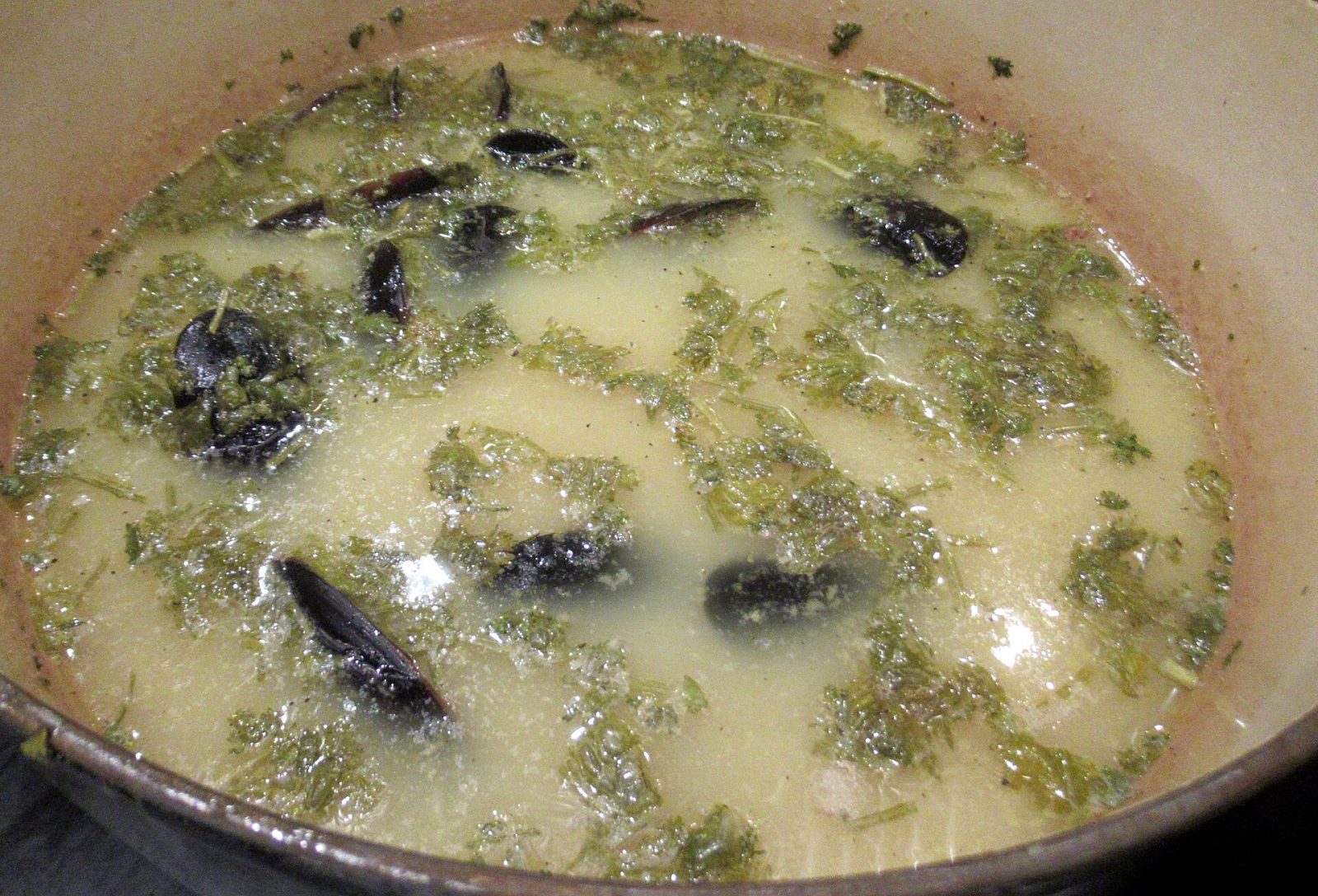
Mussels in White Wine, Shallot and Butter (Moules Marinière)
Declassified 22 August 2026
Threat assessment
- 1 No contact Nobody is in danger. Least of all the locals.
- 2 Light resistance A warmth. You mention it. Nobody responds.
- 3 Engaged You are sweating. No one else at the table is sweating.
- 4 Taking fire You have stopped talking. A child has taken your portion.
- 5 Operative down Extraction required. Locals describe this one as "not spicy".
Moules marinière is the everyday shellfish dish of the French Atlantic and Channel coasts: live mussels tipped into a covered pot over fierce heat with sweated shallot, dry white wine, thyme and butter, so they open in their own steam and give up their liquor. That liquor, strained, reduced and mounted with cold butter, is the entire sauce — no stock, no flour and no cream go into a coastal marinière. A good one tastes cleanly of the sea and the wine rather than of dairy, the mussels are plump and barely set rather than shrunken, and the broth in the bottom of the bowl is worth more than the mussels. It is a ten-minute, one-pot dish, and every minute of it matters. Photo: CNEcija12345 (CC BY-SA 4.0), via Wikimedia Commons.
// SUPPLY LIST
SCALE:
| AMT | UNIT | ITEM |
|---|---|---|
| 2 | kg | Live mussels in the shell, preferably small pole-grown bouchot mussels, scrubbed and debearded |
| 30 | g | Unsalted butter, for sweating the aromatics |
| 120 | g | Shallots (grey or long/banana shallots), peeled and diced to 3-4 mm — about 4 medium |
| 1 | clove | Garlic, peeled and thinly sliced (a common home addition; Breton purists leave it out) |
| 3 | sprig | Thyme, fresh |
| 1 | Bay leaf, fresh or dried | |
| 25 | g | Flat-leaf parsley, leaves finely chopped, stalks kept whole and tied with string |
| 300 | ml | Dry white wine — Muscadet sur lie for preference, or Gros Plant, Picpoul or dry Chenin; in Normandy, brut cider |
| Black pepper, coarsely ground | ||
| 50 | g | Cold unsalted butter, cut into 1 cm dice, to finish the sauce |
| Baguette, or hot frites, to serve |
// OPERATIONS
- 1 Buy the mussels on the day you cook them and treat them as the live animals they are: tip them into a colander set inside a bowl so the drips run away from them, cover with a damp cloth and keep them in the coldest part of the fridge at 1-4 C / 34-39 F right up to the moment they go in the pot — unlike meat, they must never be brought up to room temperature. Never seal them in a plastic bag and never store them submerged in fresh water, because both suffocate them, and dead mussels are the only genuine safety risk in this dish. Bouchot mussels are grown on wooden stakes driven into the tidal flats — the bouchots that name them — and those from the Bay of Mont-Saint-Michel carry an AOP; they are small, clean and sweet, and this recipe is built around them, while larger rope-grown or dredged blue mussels are fatter, throw more liquor and want the longer end of the cooking time. Two kilos is four bistro bowls eaten with frites and bread, or two full brasserie-sized main portions; for four of those, double everything and work in two pots, because a crammed pot steams unevenly.
- 2 No more than 20 minutes before cooking, clean the mussels under cold running water rather than in a standing sinkful: scrub each shell with a stiff brush, and pull the beard — the wiry tuft along the straight edge — sharply toward the hinge at the narrow pointed end, never toward the wide end, which tears the flesh out with it. Debearding kills the mussel, so it cannot be done hours in advance. Discard any with cracked or broken shells, any gaping one that does not close within 30 seconds of a firm tap on the worktop, and any that feels suspiciously heavy for its size, which is a shell packed with mud. Keep the rinsing brisk and never let them soak: a long bath in fresh water kills them and leaches out the salty liquor that becomes your sauce.
- 3 Dice the shallots to an even 3-4 mm, slice the garlic thinly, separate the parsley into a tied bundle of stalks and about 4 tbsp of finely chopped leaves, and put four deep bowls to warm in a low oven at 70 C / 158 F. Cold bowls kill the broth in seconds, and a lukewarm marinière tastes flat and greasy. Everything must be within arm's reach before the pot goes on: from the moment the mussels hit the heat you have five minutes and no time to chop.
- 4 Melt the 30 g of butter in a wide, heavy pot of at least 8 litres with a tight-fitting lid — stainless steel or enamelled cast iron, wide-based rather than tall so the mussels sit in a shallow layer — over medium-low heat. Add the shallots, garlic, thyme, bay and the bundle of parsley stalks and sweat for 5-6 minutes, stirring, until the shallots are slack and translucent and smell sweet, with absolutely no colour on them. Browned shallot turns the finished broth muddy and faintly bitter; marinière should taste of sea and wine, and this is the step where that is won or lost.
- 5 Pour in the 300 ml of wine, turn the heat to maximum and boil hard for 2 minutes, until the raw alcohol smell has blown off the steam and the liquid has reduced by roughly a quarter. Do not reduce it further to a syrup: the 2 kg of mussels will release 300-500 ml of their own liquor, and you need a good depth of fiercely boiling liquid in the pot so that they steam rather than stew in their own juices.
- 6 Tip in all the mussels at once, add several grinds of black pepper and add no salt whatsoever — the liquor about to come out of those shells is seawater, and salting at this stage is the single most common way this dish is ruined. Clamp on the lid and cook over the highest heat your hob will give for 3 minutes, then take the pot in both hands with a cloth, holding the lid down, and toss it vigorously two or three times (or turn them over with a long spoon) to bring the bottom layer to the top, since those shells open several minutes before the ones above them.
- 7 Replace the lid and cook for a further 1-2 minutes, then look: 2 kg of bouchot mussels take 4-5 minutes in total, larger blue mussels 5-6. They are done when nearly all the shells have gaped and the flesh is plump, opaque at the frilled edge and still visibly juicy. Pull the pot off the heat as soon as the great majority are open rather than waiting for the last stubborn few — two extra minutes shrivels every mussel in the pot into a rubbery orange nub, and that damage cannot be undone.
- 8 Lift the mussels out with a spider or tongs into the warmed bowls, or tip the lot through a colander set over a second pan to catch every drop of liquor, and cover them loosely with foil. They rest here for the 2-3 minutes it takes to finish the sauce, and residual heat carries the cooking through, which is exactly why you pulled them a touch early. Discard any that stayed firmly shut, and fish out the thyme, bay and parsley stalks so they never reach the bowl.
- 9 Let the cooking liquor settle in the pot for 30 seconds, then pour it through a fine sieve into a small saucepan, stopping when you reach the last tablespoon or two where any grit will have collected. Boil it hard for 1-2 minutes over high heat to concentrate to roughly 300 ml, then taste it: it should be saline, winey and sharp, but if it makes you wince, slacken it with a splash of wine or water now, because there is no seasoning this backwards once the butter is in — and no salt goes in at any point.
- 10 Take the pan off the heat, or drop it to the lowest possible setting, and whisk in the 50 g of cold diced butter a few pieces at a time, letting each batch melt before the next goes in, until the sauce is glossy and just thick enough to cling to the back of a spoon, about 30 seconds. It must not boil once the butter goes in or the emulsion breaks into an oil slick on top of the broth; if that starts to happen, pull it off the heat, add a splash of cold wine and whisk hard to bring it back. Do not add cream or flour here, however tempting: marinière is defined by being a sauce made only of what the mussels, the wine and the butter give up, and cream turns it into moules à la crème, which is a good dish but a different one.
- 11 Stir the chopped parsley into the sauce, pour it over the mussels, and toss each bowl once so the broth runs down through the shells. Serve immediately, while the bowls still steam, with an empty bowl on the table for shells, and either a torn baguette to mop the bottom of the bowl or hot frites (double-fried at 140 C / 284 F, rested, then 185 C / 365 F until crisp) for the full moules-frites — plus the rest of the Muscadet, chilled to about 8 C / 46 F. Eat them the coastal way, using the first empty shell as pincers to pick the rest out.