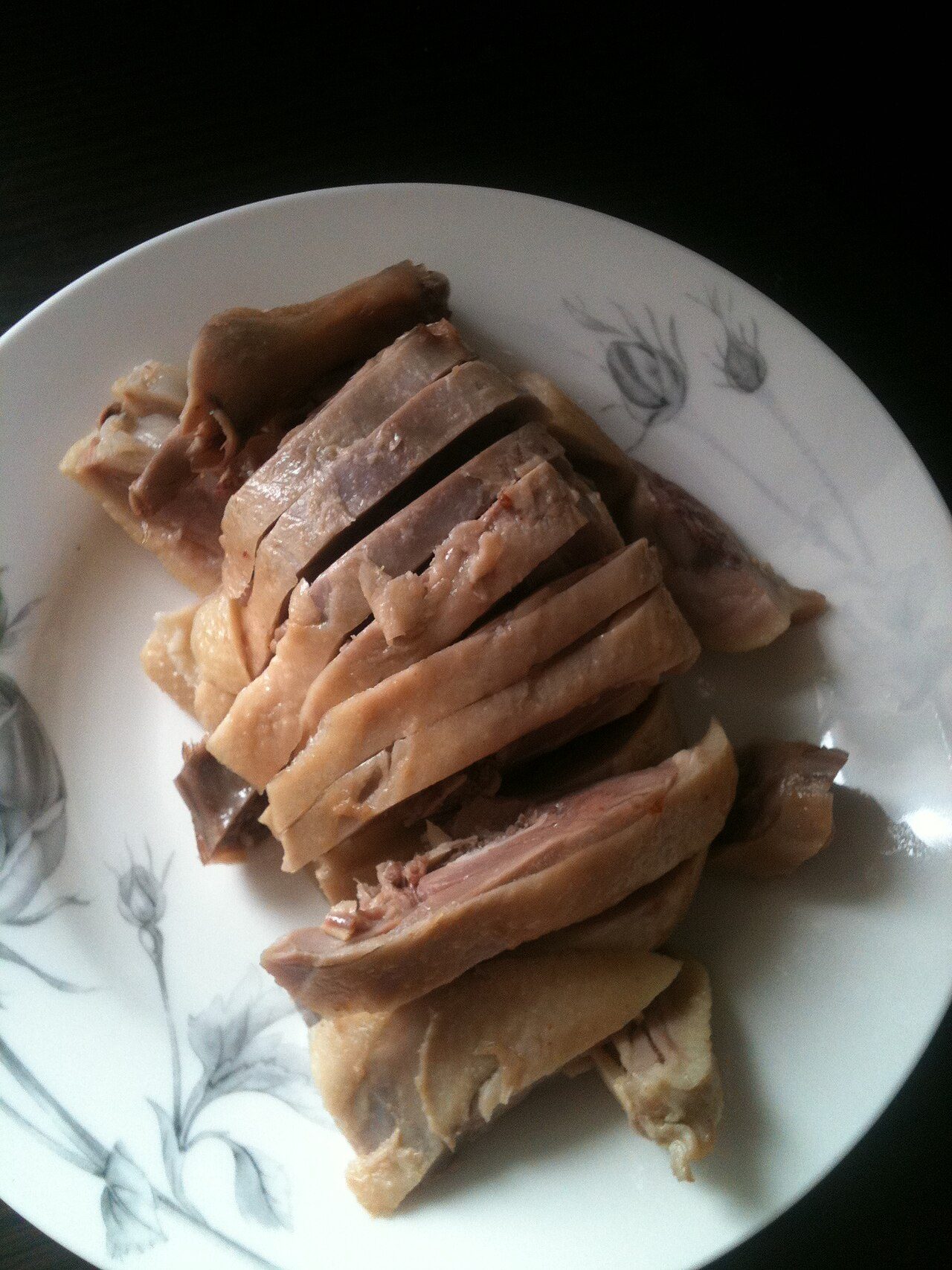
Nanjing Salted Duck (南京盐水鸭)
Declassified 22 August 2026
Threat assessment
- 1 No contact Nobody is in danger. Least of all the locals.
- 2 Light resistance A warmth. You mention it. Nobody responds.
- 3 Engaged You are sweating. No one else at the table is sweating.
- 4 Taking fire You have stopped talking. A child has taken your portion.
- 5 Operative down Extraction required. Locals describe this one as "not spicy".
Nanjing's signature cold plate: a whole duck dry-cured in toasted salt and Sichuan pepper, re-brined, air-dried until the skin is taut, then held in water that never boils so the flesh sets juicy and the skin stays pale. It is not roast duck and it is not braised — there is no colour, no sugar and no soy, only salt, aromatics and controlled temperature. A good one is firm rather than soft, faintly citrus-fragrant from the huajiao rather than peppery, and salted just hard enough that you reach for rice. It is served cold, chopped through the bone, under a spoonful of its own lightly jellied cooking liquor. Photo: NNU10.24100114 (CC BY-SA 3.0), via Wikimedia Commons.
// SUPPLY LIST
SCALE:
| AMT | UNIT | ITEM |
|---|---|---|
| 2 | kg | Whole duck, about 2 kg, head on if you can get it, rinsed, excess cavity and neck fat pulled out, any lung tissue scraped from the ribs, patted dry |
| 55 | g | Coarse sea salt or pickling salt, for the dry cure |
| 2 | tsp | Sichuan peppercorns (red huajiao), for the toasted cure salt |
| 175 | g | Fine sea salt, for the re-brine |
| 2.5 | l | Water, for the re-brine |
| 90 | g | Ginger, unpeeled, cut into 5 mm coins and bruised flat with the side of a cleaver, for the brine and the poaching liquid |
| 8 | stalk | Spring onions, whole, folded and tied into loose knots, for the brine and the poaching liquid |
| 3 | piece | Star anise, whole |
| 1 | tbsp | Sichuan peppercorns, for the brine and the poaching liquid |
| 6 | l | Water, for the poaching liquid |
| 120 | g | Fine sea salt, for the poaching liquid |
| 60 | ml | Shaoxing wine |
| 3 | tbsp | Chinkiang black vinegar, to serve (optional) |
| 15 | g | Ginger, peeled and cut into hair-fine shreds, to serve (optional) |
// OPERATIONS
- 1 Put the 55 g coarse sea salt and 2 tsp Sichuan peppercorns in a dry heavy 20-24 cm steel or cast-iron frying pan over medium-low heat and stir constantly for 4-6 minutes, until the salt turns from bright white to a faint ivory-grey, the peppercorns smell of citrus peel rather than dust, and one crushed between your fingers is brittle and snaps. Tip it straight onto a cold plate and let it cool to just warm, about 40 C (104 F), before it touches the duck: salt hot enough to sizzle sears and tightens the skin where it lands, and the cure then penetrates in blotches instead of evenly.
- 2 Pat the duck bone-dry inside and out, then rub roughly one third of the warm cure salt through the cavity, working it up along the ribs and into the neck opening, and the rest firmly over the outside, pressing hardest into the breast, the thick of the thighs and the two hollows under the wings. Sit it breast-up on a rack over a tray, cover loosely, and refrigerate at 3-5 C (37-41 F) for 12 hours, turning it breast-down after 6 hours. Do not push the cure past 16 hours at this salt rate; beyond that the breast crosses from seasoned into hard, dry and ham-like, and no amount of poaching brings it back.
- 3 Make the re-brine: bring 1 l of the brine water to the boil in a saucepan with the 175 g fine sea salt, 40 g of the bruised ginger, 4 spring onion knots, 1 star anise and 1 tsp of the tablespoon of Sichuan peppercorns, stirring until the salt has fully dissolved and the liquid runs clear rather than cloudy, then take it off the heat, stir in the remaining 1.5 l water cold, and chill the whole lot to below 10 C (50 F) — allow about an hour, and do not start the next step until it is genuinely cold to a fingertip. Tip the accumulated liquid out of the duck's cavity and discard it, brush off any undissolved cure salt, then settle the duck into a snug 4-5 l container or a food-grade brining bag and pour the cold brine over: 2.5 l only covers the bird if the vessel hugs it, so in a wide tub it will sit half exposed and cure in stripes. Weight it with a small plate if it floats, refrigerate for 4 hours, and never pour warm brine over the duck — it starts to cook the skin, which then goes grey and slack instead of white and tight.
- 4 Lift the duck out, rinse it briefly under cold running water inside and out to take off the surface salt, and pat it thoroughly dry with kitchen paper. Hang it by the neck, or stand it on a rack, in front of a fan in a cool room for 8 hours, or leave it uncovered on a rack in the fridge overnight, until the skin is matte, taut and papery to the touch and a fingertip laid on the breast comes away clean and dry. Skin that is still tacky is the commonest reason home versions come out flabby and blotched: the dry surface is the only barrier between the poaching water and the fat underneath.
- 5 If the duck was dried in the fridge rather than in front of a fan, stand it on the counter for 45 minutes first — a bird going in at 4 C (39 F) rather than about 16 C (61 F) will not make temperature on the timings below and the thighs finish raw. Choose the smallest pot the duck actually fits in, snugly, with only 2-3 cm around it — a 26-28 cm, 10-12 l stockpot or tall casserole — because a roomy pot needs more water and dilutes the brine that is holding the seasoning in. Put in the 6 l water, 120 g fine sea salt, the remaining 50 g ginger, the 4 remaining spring onion knots, 2 star anise, the remaining 2 tsp Sichuan peppercorns and the 60 ml Shaoxing wine. Bring it to 85 C (185 F) on a probe thermometer over medium-high heat, about 25 minutes, which looks like a lazy thread of small bubbles rising from the base with the surface only shivering and never breaking, and hold it there for 10 minutes so the aromatics open and the salt is evenly through the pot.
- 6 Holding the duck by the neck over the pot, ladle the hot liquid into the cavity until it fills, then tip it straight back out, and repeat twice more. This cavity flush (guantang) is the step home cooks skip and shouldn't: the cavity is a cold pocket, and pre-heating it means the inside and outside climb together, so the breast finishes at the same moment as the thighs instead of drying out while they catch up.
- 7 Lower the duck in breast-down — it should be covered by about 2 cm; if it is not, top up with just-boiled water from a kettle, adding as little as you can get away with — and bring the pot back to 85 C (185 F) over medium heat, which takes 8-12 minutes. Now hold it between 82 and 88 C (180-190 F) for 20 minutes, riding the burner and lifting the pot half off the ring if it climbs. A clipped-on thermometer is not optional here: if the water breaks into a genuine boil even for a minute the skin splits, the fat emulsifies and clouds the liquid, and the breast turns grainy and dry. This is the single failure that ruins the dish.
- 8 Lift the duck clear with tongs hooked through the cavity, tilt it over the pot so the cooled cavity liquid pours back in, then lower it back down breast-up. Bring the liquid back to 85 C (185 F) and hold it there for a further 20 minutes, watching that the surface never does more than shiver.
- 9 Turn the heat off, cover the pot and leave the duck sitting in the hot liquid for 20 minutes. Then probe the thickest part of a thigh, keeping clear of the bone: it should read 75-78 C (167-172 F) and the juice at the thigh joint should run clear with no pink. If it reads below 75 C (167 F), return the pot to low heat, bring it back to 85 C (185 F) and hold for another 10 minutes before probing again, rather than raising the heat to catch up — chasing the number with a hard boil undoes every gentle minute that came before it.
- 10 Lift the duck out, drain the cavity into the pot, and set it breast-down on a rack over a tray to cool to room temperature, about 1 hour; resting it breast-down lets the juices settle back into the breast instead of draining into the cavity. Meanwhile strain 500 ml of the poaching liquid through a fine sieve into a small saucepan and simmer it steadily down to about 250 ml, 15-20 minutes, then pour in whatever juices have collected in the resting tray — that drip is where most of the gelatin actually is — and chill it. Straight poaching liquid is far too dilute to gel no matter how long you chill it; reduced by half it sets under a pale cap of fat to a soft, barely trembling jelly, which is the sauce. If it is still slack after 4 hours in the fridge, reduce it a little further and chill again.
- 11 Refrigerate the cooled duck uncovered on its rack for at least 4 hours, and up to 2 days. Salted duck is a cold dish and must be genuinely cold to the centre before it is cut, because carving it warm sends the juices out onto the board, tears the fibres instead of slicing them and drags the skin off the meat.
- 12 Chop the cold duck through the bone with a heavy cleaver into pieces about 2 cm wide and 5 cm long, committing to one confident stroke per cut, since hesitant repeated blows splinter the bone into the meat. Lay the pieces skin-side up on a shallow platter in roughly the shape of the bird, lift off and discard the set fat cap from the chilled liquor, and spoon 3-4 tbsp of the jelly over the top. Serve cold at the start of the meal with plain steamed rice or rice congee and a simple green vegetable, with an optional saucer of the 3 tbsp Chinkiang vinegar and 15 g fine ginger shreds alongside; Nanjing cooks will tell you a properly made salted duck needs nothing at all, but the vinegar sits on plenty of Nanjing tables regardless.