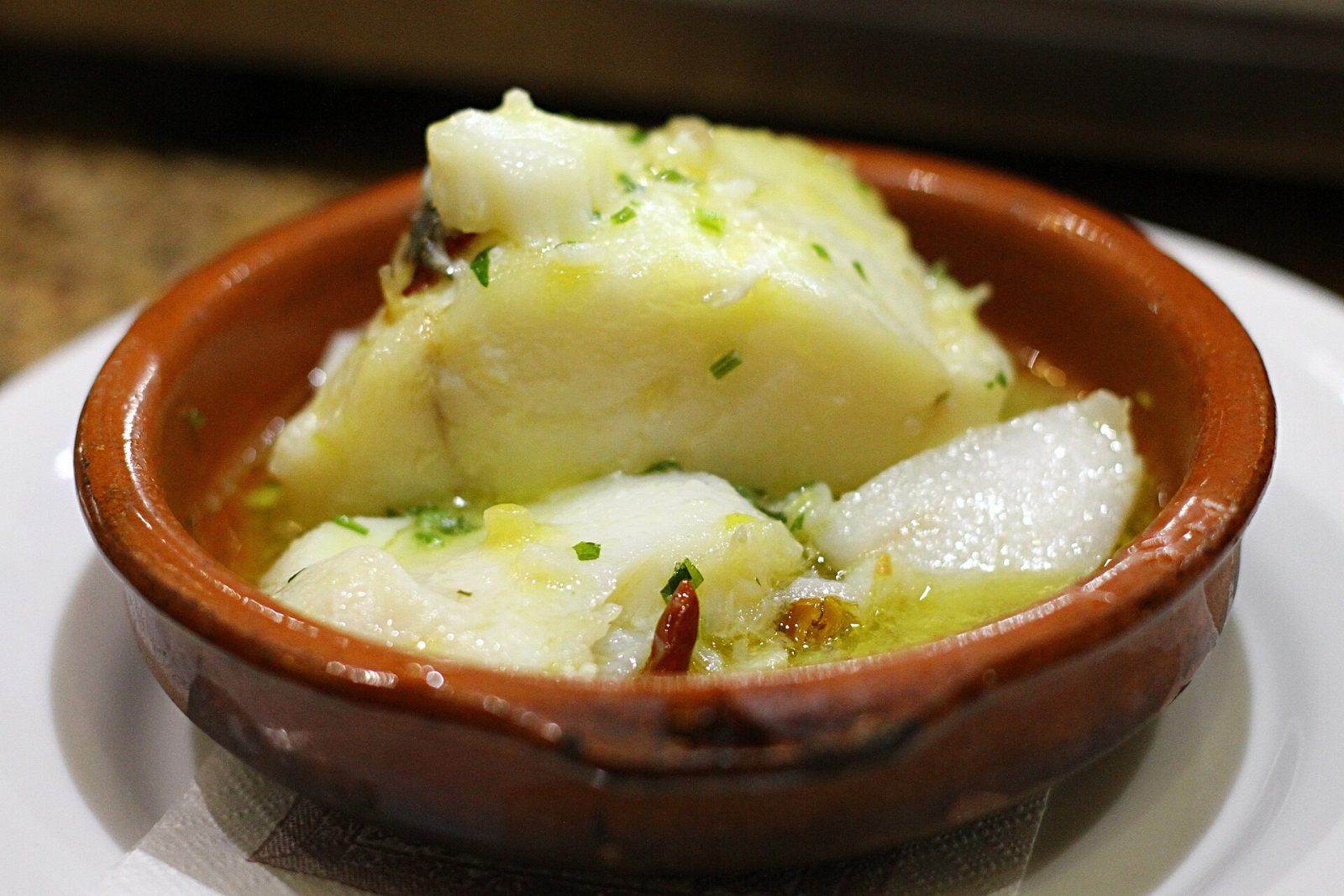
Salt Cod in Pil-Pil Sauce (Bacalao al Pil-Pil)
Declassified 22 August 2026
Threat assessment
- 1 No contact Nobody is in danger. Least of all the locals.
- 2 Light resistance A warmth. You mention it. Nobody responds.
- 3 Engaged You are sweating. No one else at the table is sweating.
- 4 Taking fire You have stopped talking. A child has taken your portion.
- 5 Operative down Extraction required. Locals describe this one as "not spicy".
Bacalao al pil-pil is the four-ingredient acid test of Basque cooking: salt cod poached gently in garlic oil, then coaxed into a thick ivory sauce built entirely from the gelatin in the fish's own skin, a mayonnaise with no egg in it. It belongs to Bizkaia, where salt cod has been kitchen currency since the Basque fleets fished the North Atlantic. A good one has a sauce that is pale, glossy and thick enough to coat the back of a spoon, garlic that tastes sweet rather than bitter, and cod that flakes in large moist sheets instead of shredding. Everything hangs on temperature: too hot at any stage and there is no pil-pil at all. Photo: Jun (CC BY-SA 2.0), via Wikimedia Commons.
// SUPPLY LIST
SCALE:
| AMT | UNIT | ITEM |
|---|---|---|
| 600 | g | Dried salt cod loin (bacalao en salazón), thick centre cut 3-4 cm deep, skin on, pin bones removed, cut into 4 equal pieces |
| 15 | l | Cold water, for desalting (six fills of roughly 2.5 litres each: the first soak plus five changes) |
| 400 | ml | Extra virgin olive oil, mild and fruity (arbequina or a soft Basque-style blend, not a bitter picual) |
| 8 | clove | Garlic cloves, peeled, green germ removed, sliced into 2 mm rounds |
| 1 | piece | Dried guindilla or cayenne chilli, halved lengthways and seeds shaken out |
| 2 | tbsp | Warm water, about 40°C/104°F, for building, loosening and rescuing the emulsion |
| Fine sea salt, only if the sauce needs it at the end | ||
| Crusty white bread, thickly sliced, to serve |
// OPERATIONS
- 1 Rinse the salt cod under cold running water for 1 minute, rubbing off every surface salt crystal, then lay the pieces skin side up and not overlapping in a wide glass, ceramic or plastic container (avoid bare aluminium, copper or cast iron, which react with the brine and can taint the fish). Cover with cold water to a depth of at least 5 cm above the fish, roughly 2.5 litres for this quantity, and refrigerate at 4°C/39°F. Skin side up is not fussiness: salt leaves the flesh and sinks, and fish sitting in that heavy layer at the bottom re-absorbs it.
- 2 Change the water every 8 hours, five changes after the first soak and six fills in all, for a total of 48 hours on 3-4 cm loins (32-36 hours if your pieces are only 2 cm thick), lifting the fish out each time rather than pouring the water off, so the settled salt stays behind in the old water. Never desalt on the worktop: at room temperature the cod turns slimy and sour long before the salt is out, and 48 hours is the outer limit even at 4°C/39°F, because past that the flesh goes woolly and starts shedding the very gelatin the sauce depends on.
- 3 At the 36-hour mark, cut a sliver from the thickest part of one piece and taste it raw: it should taste like a well-seasoned fresh fish, gently saline and sweet, with no sting at the back of the throat. If it still stings, give it one more water change and another 8-12 hours, then taste again. Lift the pieces out, pat them bone dry on both sides with kitchen paper, and rest them on a rack skin side up in the fridge, uncovered, for 1 hour to firm and dry the skin, then 20 minutes at room temperature; a fridge-cold centre forces you to poach longer and hotter, which is precisely how the emulsion is lost.
- 4 Set a 24-26 cm glazed earthenware cazuela over a heat diffuser on the lowest gas flame, or use a heavy stainless or carbon steel pan with sloping sides. Size it so the four pieces will sit snugly in a single layer with barely a finger's width between them: in too wide a pan the 400 ml of oil spreads into a shallow film and never comes far enough up the fish to poach it. Earthenware is traditional and holds heat beautifully, but put it on the burner cold and bring it up slowly; a cazuela dropped onto a hot ring will crack. Pour in all 400 ml of the oil and add the sliced garlic and the halved chilli from cold.
- 5 Bring the oil slowly up to about 120°C/248°F over 6-8 minutes, until the garlic slices float, turn pale straw-gold and give off a quiet, steady hiss, then lift out every slice of garlic and both halves of chilli with a slotted spoon onto a plate and reserve them for the finish. Pull the garlic a shade earlier than looks right: it carries on colouring in its own heat once it leaves the pan, and past gold it turns bitter, with no rescuing 400 ml of bitter oil.
- 6 Take the pan off the heat and let the oil fall to about 75°C/167°F, which for 400 ml takes 4-5 minutes; a probe thermometer is worth the trouble here, but without one the oil is right when a test slice of garlic sends up a lazy trickle of pinhead bubbles and does not sizzle. Slide the cod in skin side down, return the pan to the lowest possible heat, and hold the oil between 65°C/149°F and 75°C/167°F, starting at the top of that range because the cool fish will pull the temperature down several degrees as it goes in. Nothing above 80°C/176°F, ever: at frying temperature the albumin sets, the skin gives up its collagen in white curds instead of a smooth gel, and there is no pil-pil to be made.
- 7 Poach skin side down for 6 minutes, then turn each piece with a fish slice and give it 5 minutes more skin side up for 3 cm loins, 8 minutes and 7 for 4 cm ones. It is done when the flakes just begin to part at the edges under gentle pressure, the flesh has turned from translucent to opaque white, and the oil around the fish has gone visibly cloudy with milky gelatin; that cloudiness is the sauce announcing itself, and if the oil is still clear the skin has not released its collagen and the fish needs a few minutes more.
- 8 Lift the cod onto a warm plate, skin side up, and let it sit while you build the sauce. Everything milky and white clinging to the base of the pan and pooling around the fish is the gelatin, which is to say it is the sauce; tip any that runs off onto the plate straight back into the pan and scrape the base gently with a silicone spatula to loosen the rest.
- 9 Pour the oil off into a heatproof jug, leaving only about 4 tbsp/60 ml behind in the pan along with every drop of the cloudy gelatin. This is the single most common place the dish is lost: a base carrying 150 ml of oil is already too dilute to take, and no amount of stirring will thicken it. Let pan and jug stand 8-10 minutes until the oil has cooled to 40-45°C/104-113°F, warm but comfortable on a fingertip; much colder and the gelatin stiffens and will not disperse, much above 60°C/140°F and it thins too far to hold the oil.
- 10 Off the heat, add 1 tbsp of the warm water to the pan, then take a fine-mesh sieve, lay it flat against the base and work it in continuous, unhurried circles for 2-3 minutes until the oil clouds, thickens and starts to look like loose mayonnaise. The old way is to hold the cazuela by its ears and swing it in a steady circular vaivén, and it does work, but the sieve is a long-established shortcut in Bizkaia kitchens, it gives the same sauce in a fraction of the time, and nobody there considers it cheating. If the base has not clouded after 3 minutes it has gone too cool: set it over the lowest heat for 20 seconds, no longer, and carry on circling.
- 11 Once the base has taken, add the reserved oil back in a thin thread, about 1 tbsp at a time, circling without pause and letting each addition vanish completely before the next goes in; expect to work in 250-300 ml over 8-10 minutes. Stop the moment the sauce is pale ivory, glossy and thick enough to hold a ripple for a second when you tilt the pan, because the skin from four pieces of cod will only carry so much oil and forcing in the last of it is exactly how a good pil-pil turns thin and greasy; oil left in the jug is a success, not a failure, and it keeps a week in the fridge. If the sauce stiffens too far, a teaspoon of warm water brings it straight back. Do not reach for a stick blender: it will give you an emulsion, but it beats in air and turns the sauce chalk-white, foamy and stiff, more mousse than pil-pil. If instead it splits into a greasy pool, tip nearly all the oil back into the jug, leave a tablespoon of the gelatin-rich liquid behind, add 1 tsp of the warm water and rebuild with the sieve, returning the split oil drop by drop; nothing is lost.
- 12 Slide the cod back in skin side up, set the pan over the lowest heat or a diffuser for 2-3 minutes, keeping it moving in the same circular motion, until the sauce is warm to the lip at around 50°C/122°F and the fish is heated through; let it come anywhere near a simmer and the sauce breaks. Taste and add a pinch of fine sea salt only if the desalting went a shade far, then rest it off the heat for 2 minutes to settle, scatter over the reserved garlic slices and lay the chilli halves on top. Take the cazuela straight to the table, because pil-pil dulls and sets as it cools, and serve it with plenty of thickly sliced crusty white bread for the sauce and a cold bottle of txakoli or a young white Rioja; in Bizkaia nothing else goes on the plate.