Escalivada (Catalan Ember-Roasted Vegetables)
Declassified 22 August 2026
Threat assessment
- 1 No contact Nobody is in danger. Least of all the locals.
- 2 Light resistance A warmth. You mention it. Nobody responds.
- 3 Engaged You are sweating. No one else at the table is sweating.
- 4 Taking fire You have stopped talking. A child has taken your portion.
- 5 Operative down Extraction required. Locals describe this one as "not spicy".
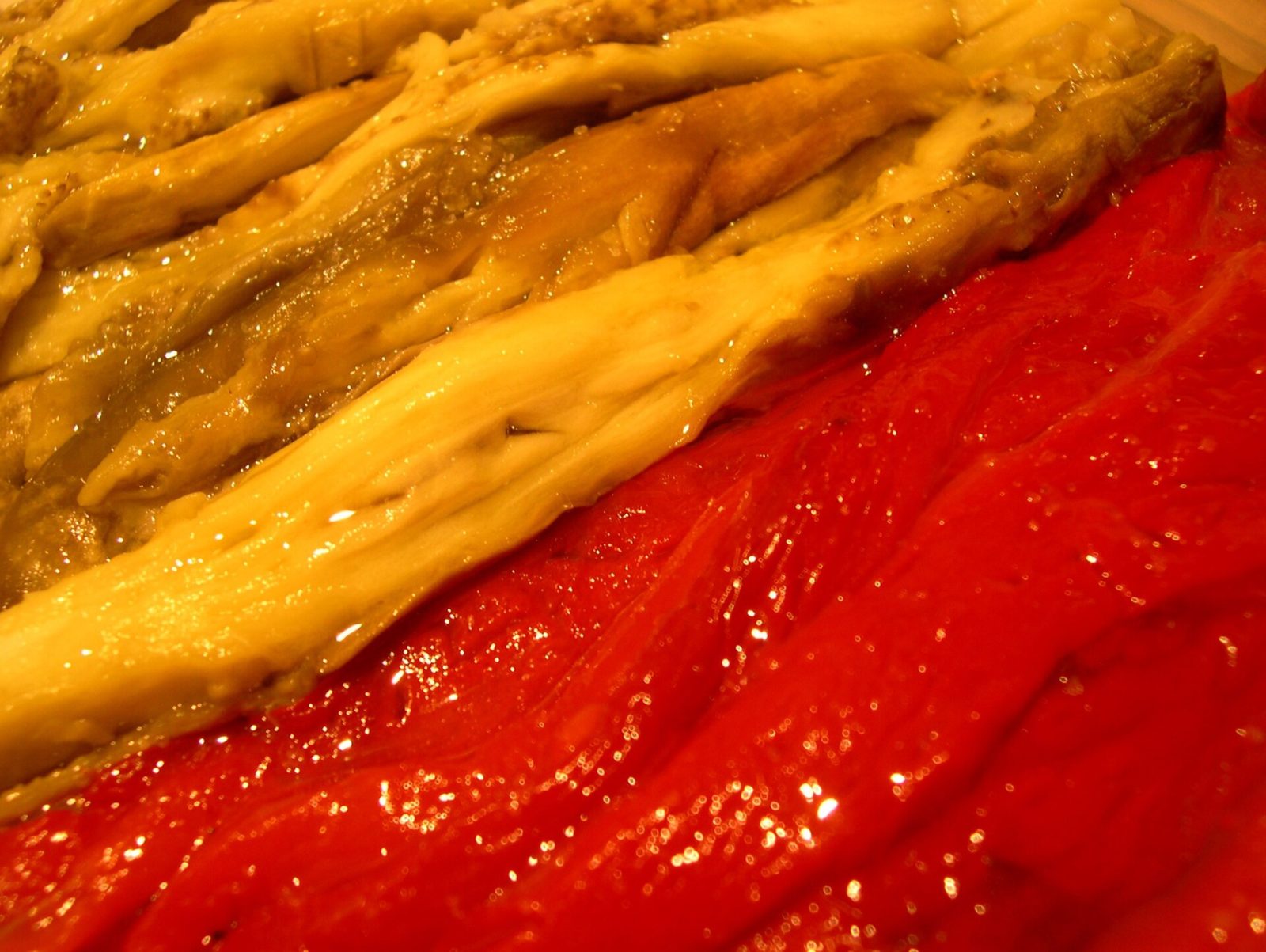
Escalivada is Catalonia's essential vegetable dish: whole aubergines, red peppers and onions cooked hard in wood embers or a very hot oven until the skins blister and the flesh collapses, then peeled, torn into strips by hand and dressed with little more than their own smoky roasting juices, good olive oil and salt. The name comes from the Catalan verb escalivar, to cook in the embers, and that is effectively the whole recipe: one hard technique instead of a long ingredient list. A good one tastes of smoke and sweetness before it tastes of vegetables, and the strips are silky rather than watery, which means the aubergine went further than most cooks think it should. It is eaten at room temperature with anchovies and toasted country bread, and it is markedly better an hour after you make it than straight out of the oven. Photo: Emi Yañez (CC BY 2.0), via Wikimedia Commons.
// SUPPLY LIST
SCALE:
| AMT | UNIT | ITEM |
|---|---|---|
| 2 | Aubergines, firm and glossy, about 350 g each, left whole and unpeeled with the stalks on | |
| 3 | Red peppers, thick-walled and unblemished, about 200 g each, left whole with the stalks on | |
| 2 | Onions, yellow or sweet Figueres onions, about 180 g each, papery skins left on and root plate intact | |
| 2 | Ripe plum tomatoes, about 100 g each, left whole (optional, standard in the Empordà and around Girona) | |
| 1 | Garlic, whole head, papery skin on, top 1 cm sliced off (optional but recommended) | |
| 3 | tbsp | Extra virgin olive oil, for rubbing the vegetables before roasting |
| 1 | tsp | Coarse sea salt, scattered over the vegetables before roasting so it seasons the juices they weep into the tin |
| 75 | ml | Extra virgin olive oil, fruity Catalan Arbequina if you can get it, for the dressing |
| 1 | tsp | Sherry vinegar or Catalan red wine vinegar (optional; many households use none at all) |
| Flaky sea salt, to finish | ||
| 8 | Anchovy fillets in olive oil, l'Escala if possible, drained (optional; omit to keep the dish vegetarian) | |
| 60 | g | Black olives, Empeltre or Arbequina, unpitted |
| 8 | slice | Pa de pagès or plain coca bread, cut into 2 cm slices and toasted |
// OPERATIONS
- 1 Decide your heat source and commit to real heat. Over a live fire, escalivada is cooked directly on the dying embers of a wood or charcoal fire once the flames have gone and the coals are grey-edged: the vegetables sit straight on the coals and are turned with tongs every 8-10 minutes for 30-40 minutes, until the skins are black all over. In a domestic kitchen almost every Catalan cook now uses the oven, and that is an accepted shortcut rather than a compromise, provided you run it properly hot — heat the oven to 230C/450F (210C/410F fan) with a rack in the upper third, and line a heavy 30 x 40 cm roasting tin with foil, because the sugars that weep out of the vegetables carbonise onto bare metal and never come off. Set a large bowl and a plate that covers it next to the oven before you start: vegetables go into that bowl the moment they come out, not at the end. A moderate oven is the classic failure — at 180C/350F the flesh dries and turns leathery long before the skin blisters.
- 2 Wipe the vegetables dry with a cloth rather than washing them wet, since surface water makes the skins steam instead of blister, then prick each aubergine eight times with the tip of a paring knife, pushing right through the skin into the flesh and spacing the holes evenly around the belly. Skipping this is how people end up scraping burst aubergine off the roof of the oven: the flesh turns to steam faster than an intact skin can vent it. Leave the onions in their papery skins with the root plate intact so they hold together, leave the pepper stalks on, and slice the top 1 cm off the garlic head if you are using it.
- 3 Rub every vegetable all over with the 3 tbsp of olive oil — a thin film on every surface, not a puddle in the tin — and scatter the 1 tsp of coarse sea salt over them; the skins are going in the bin, but that salt dissolves into the juices that run out and those juices become the dressing. Lay everything on the lined tin with at least 3 cm of clear space around each piece, the garlic head cut-side up in a corner. Crowding is the difference between roasting and steaming: if it will not all fit with air between the pieces, use two tins on two shelves and swap them halfway.
- 4 Roast, turning everything with tongs every 20 minutes, and pull each vegetable out as it is ready rather than cooking everything to a single timer. Tomatoes come out at about 25 minutes, as soon as the skins split and slip; peppers at 35-45 minutes, when the skin is blackened in broad patches and has ballooned away from the flesh; aubergines at 50-60 minutes, when they have visibly deflated, the skin is dull and wrinkled, and a skewer pushed into the thick end by the stalk meets absolutely no resistance; onions at 65-75 minutes, when they collapse under a squeeze with tongs and the base is dark and sticky. Undercooked aubergine is the one failure that cannot be rescued later — it stays spongy and tastes of raw tannin — so if you are in any doubt give it another 10 minutes; short of actually burning it to charcoal, you cannot overcook it.
- 5 If you used the oven and want the smoke that embers would have given, char each pepper and aubergine as it leaves the tin rather than waiting until the end, holding it with tongs directly over a gas burner turned to full flame for 4-6 minutes, turning until roughly two thirds of the surface is properly black; with an electric hob, slide the pieces onto a small tray 8 cm under a fiercely hot grill for 5-8 minutes instead. You are burning the skin, not the flesh, and the skin is going in the bin, so timidity at this stage is exactly what produces bland, boiled-tasting escalivada.
- 6 Drop each vegetable into the large bowl the moment it is charred and keep the bowl covered with the upturned plate throughout, adding to it as the peppers, then the aubergines, then the onions come out — in Catalan kitchens a sheet of newspaper laid over the top does the same job. Leaving a cooked pepper standing uncovered on the tin while the onions finish is the mistake here: the skin dries onto the flesh and will not peel cleanly. Once the last vegetable is in, leave everything covered for 20 minutes and no more than 30; the trapped steam lifts the skins away and finishes the aubergine from the inside, but past half an hour the flesh goes waterlogged and greyish. Scrape every drop of juice from the foil into the bowl.
- 7 Peel everything by hand while it is still warm, working over a second bowl so every drop of juice is caught — the pepper skins should come away in sheets, the aubergine skin should strip off like a jacket, the tomato skins slide off in one piece, and the onion's papery layers plus the tough first layer beneath pull straight off. Never rinse the vegetables under the tap to speed this up: it is the one shortcut that destroys the dish, because the smoke lives in the thin film of blackened juice on the surface of the flesh and water carries all of it down the drain. Leave the odd fleck of black skin behind, it belongs there. Pull out the pepper stalks and seed cores and tip the liquid pooled inside each pepper into the juice bowl.
- 8 Tear the flesh into strips with your fingers, following the grain: aubergine into strips 1.5-2 cm wide, peppers into strips of the same width, tomatoes torn into rough petals with the watery seed pockets flicked into the juice bowl, and onions halved through the root, the hard root plate cut away and discarded, then separated into petals. Do not reach for a knife — torn edges are ragged and hold the oil where clean-cut ones shed it, and the loose, hand-torn look is simply what the dish is. Leaving the woody root plate in is the one place a knife is genuinely needed; it never softens and it is unpleasant to bite.
- 9 Strain the collected juices through a fine sieve into a small bowl — you should have 60-80 ml of dark, smoky liquid — and whisk in the 75 ml of extra virgin olive oil, squeezing in the soft pulp from the roasted garlic head if you used one, until it comes together into a loose, glossy dressing. Pouring those juices away is the most common mistake in home escalivada and is exactly what makes a flat one. If you want the vinegar, whisk in no more than 1 tsp now; plenty of Catalan households add none at all, and it should never register as acidity, only as lift.
- 10 Arrange the strips on a shallow platter in loose overlapping rows, alternating the red of the peppers with the pale aubergine, the onion and the tomato rather than tossing everything into a heap, spoon the dressing evenly over the top so it runs down between the layers, and season with flaky sea salt scattered from a height. Taste a strip before you stop salting: the vegetables carry almost none of the roasting salt through the peeling, so a platter that seems seasoned when hot will taste flat at room temperature.
- 11 Leave the platter at room temperature for at least 1 hour before serving, and up to 4 — the strips need that time to drink the oil and juices, and escalivada served immediately tastes thin, with the oil sitting separate on top. It is better still made the morning before. Refrigerate it only if you must, in a covered container under a film of oil, and then bring it back to full room temperature for an hour and re-dress it with a little fresh oil, because fridge-cold escalivada is dull and waxy and wastes everything you just did.
- 12 Serve at room temperature with the toasted slices of pa de pagès or coca and the black olives alongside, and — unless you are keeping it vegetarian — the anchovy fillets laid in a lattice over the vegetables, which is how it arrives at most Catalan tables. It is also the standard partner for grilled botifarra, lamb chops or salt cod, and anything left over goes on a coca or into a sandwich the next day.